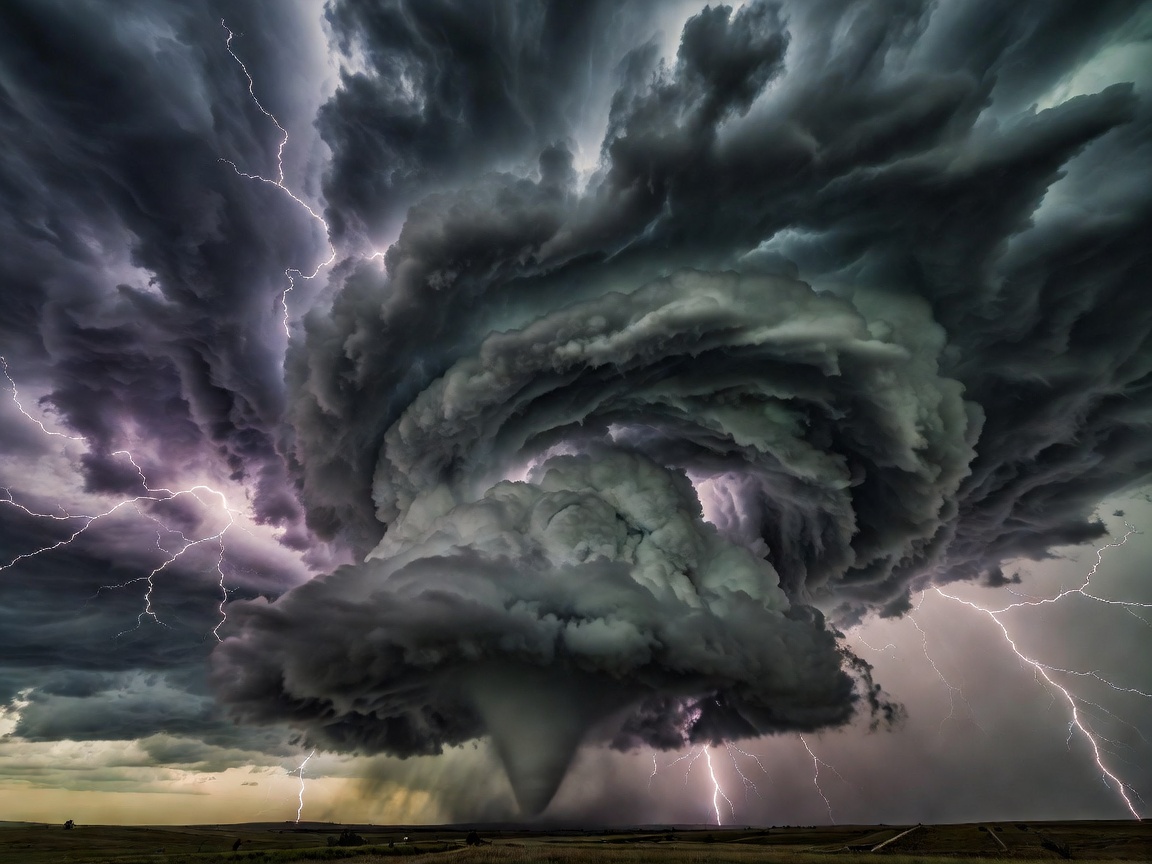
During the spring meteorological chase season, our research team deployed hardened mobile pressure pods equipped with piezoelectric microbarographs into the direct path of a violent, multi-vortex EF5 supercell in Central Oklahoma.
Hydrostatic Breakdowns at the Core Boundary
As the primary condensation funnel passed within 180 meters of Pod-3, our instrumentation recorded an unprecedented localized pressure drop of 85 millibars in under 12 seconds. This violent pressure differential creates extreme explosive structural loading on buildings, well beyond wind vector forces alone.
Thermodynamic Profile & Equivalent Potential Temperature (Theta-e)
Surface-based CAPE values exceeded 4,800 J/kg with 0-1km helicity values topping 650 m²/s². The inflow notch maintained an exceptionally rich moisture channel directly fed by Gulf Air masses, accelerating vertical updrafts past the tropopause into severe overshooting tops reaching 60,000 feet.
Conclusion for Field Tracking Deployments
High-frequency microbarograph arrays deployed in tight grids provide crucial ground-truth data to validate dual-polarization doppler radar estimates. Modern storm chasing teams must combine real-time pressure sensor feedback with mobile radar arrays to safely predict sudden tornadic path shifts.